The waiting is the hardest part
Every day you see one more card
You take it on faith, you take it to the heart
The waiting is the hardest part
- Tom Petty and The Heartbreakers
I'm terrible at waiting. I get antsy and anxious. I tend to jump ahead and guess what's coming. I'll use any small thing as an omen. Good parking place = good luck. Long wait = bad news they're trying to sort out. Good nurse stick on my blood draw = easy chemo. For a scientist, I'm awfully superstitious.
I had a PET scan on Monday, and Wednesday I had my follow up with the nurse practitioner (NP) to find out about the scan results. Naturally, I was anxious. That morning I was running late (bad omen), but I caught a lot of green lights on Kingston Pike (good omen). My parking place was decent (neutral). There were no annoying loud-talking people in the waiting room (good). The nurse stick was easy (good). Then I had to wait about 40 minutes for the NP (worse). It wasn't my favorite NP, Lisa, that walked in (bad). I've almost worked myself into a tizzy before she starts talking.
The news was mixed but generally good. I think. The lesions on my lungs are now showing no activity (no cancer metabolism going on there). That's good. It's what I've been praying for since my last scan in June. The mass on my liver is more active but generally the same size as the last scan. My tumor marker was up but not drastically so. It was 1.5 in November and 4.9 in December. Below 3 is normal. I extended my chemo to every three weeks in October and November to accommodate travel plans. I guess it is possible for the change in schedule to impact the tumor marker number, but I'm not a doctor. This is cause for attention but not panic.
I will see my surgeon in three weeks and my oncologist again after that. Three weeks! That's the earliest appointment I could get. That's three weeks to speculate, worry, and stew on it. Three weeks to generate a proper omen scorecard. Or depending on my mood, it's three weeks of freedom without chemo or a doctor's appointment. I will try to focus on the latter and keep the worrying and tallying at bay. Luckily, I have the distraction of the holidays and lots to do at work.
God is teaching me patience, and I'm a slow learner, apparently.
Friday, December 23, 2016

Sunday, August 28, 2016
Life Between Treatments
One of the biggest adjustments of my life was becoming a mother. I went from having minimal schedule constraints to having a cuddly 6 lb. dictator telling me what I was going to do next. I quickly realized that my new mom life would be broken up into 2-3 hour intervals because that was the time I had between feedings - feed, diaper change, soothe and snuggle, nap, and repeat. In between I had 2 hours to eat, sleep, shower, run errands, etc. Most of the time I opted for sleep. That phase didn't last long, and it was 10 years ago. However, I still remember what a life change it was for me.
Now chemo has put my life on a two-week schedule - chemo, recovery, rest, feeling okay, feeling good, feeling nearly normal, and repeat. My typical chemo cycle starts on a Wednesday with chemo for half the day and then a nap. Thursdays if I feel okay, I'll run errands, do a few things around the house, or go shop with my mom. If I'm feeling puny, I stay home and nap. Usually on Fridays I'm exhausted. I don't sleep well because of the steroids and the fact that I'm wearing a stupid fanny pack with my pump in it. Saturdays are generally as lazy as I can get way with. On Sunday, I'm perking up and getting ready to go back to work on Monday. I basically lose 4-5 days each cycle, and then I get 9-10 relatively good days that follow. The weekend before I start the next cycle is usually really good. I have more energy and feel like doing things. I feel almost like someone who doesn't have cancer.
This has become routine for me after 17 treatments. I was pretty bummed out by the thought of taking chemo "indefinitely". Who wants to spend the rest of their life on this sick-to-get-well roller coaster? However, after a few days of wallowing, thinking, praying, and sleeping, I decided that I need to focus on the positive and focus on living. I have been putting off the big things until "I feel better" as if joy is something that should suffer from my chronic procrastination.
I've made some changes in my life and my attitude that will allow me to make the most of those well days between treatments. On thing has been to pare down our stuff. I don't want to spend my weekend cleaning the house, so I've been streamlining our household so that it requires less of my time. Sara has been chipping in on chores so that we can get stuff done in less time. I have also pared down our commitments. Sara still has her activities - swimming, girl scouts, drama, etc. Those things are important to her as they represent normalcy. I want her to be able to hang on to normalcy as much as possible. Our life may have been turned upside down, but I don't want this period in her childhood to be marked by isolation, boredom, or anger about missing out. In order to manage all her activities, I must either take on less or delegate more in my role on those activities. In order to do this I had to abandon guilt of being the slacker mom and the control of having things my way. Both of these were hard to let go.
I resolved to use my well time for fun, joy, adventure, or just quiet peace at home with Sara. I'm planning a few weekend trips for Sara and I this fall. Plus I've booked my flight and am planning a rambling geologic and sightseeing road trip to Wyoming over fall break. This one is for grown ups - just me and Shawn. Having something to look forward to helps me think and talk about life as if I'm a normal healthy person. It helps me to keep moving forward. I want to spend my good days being as normal as possible.
Now chemo has put my life on a two-week schedule - chemo, recovery, rest, feeling okay, feeling good, feeling nearly normal, and repeat. My typical chemo cycle starts on a Wednesday with chemo for half the day and then a nap. Thursdays if I feel okay, I'll run errands, do a few things around the house, or go shop with my mom. If I'm feeling puny, I stay home and nap. Usually on Fridays I'm exhausted. I don't sleep well because of the steroids and the fact that I'm wearing a stupid fanny pack with my pump in it. Saturdays are generally as lazy as I can get way with. On Sunday, I'm perking up and getting ready to go back to work on Monday. I basically lose 4-5 days each cycle, and then I get 9-10 relatively good days that follow. The weekend before I start the next cycle is usually really good. I have more energy and feel like doing things. I feel almost like someone who doesn't have cancer.
This has become routine for me after 17 treatments. I was pretty bummed out by the thought of taking chemo "indefinitely". Who wants to spend the rest of their life on this sick-to-get-well roller coaster? However, after a few days of wallowing, thinking, praying, and sleeping, I decided that I need to focus on the positive and focus on living. I have been putting off the big things until "I feel better" as if joy is something that should suffer from my chronic procrastination.
I've made some changes in my life and my attitude that will allow me to make the most of those well days between treatments. On thing has been to pare down our stuff. I don't want to spend my weekend cleaning the house, so I've been streamlining our household so that it requires less of my time. Sara has been chipping in on chores so that we can get stuff done in less time. I have also pared down our commitments. Sara still has her activities - swimming, girl scouts, drama, etc. Those things are important to her as they represent normalcy. I want her to be able to hang on to normalcy as much as possible. Our life may have been turned upside down, but I don't want this period in her childhood to be marked by isolation, boredom, or anger about missing out. In order to manage all her activities, I must either take on less or delegate more in my role on those activities. In order to do this I had to abandon guilt of being the slacker mom and the control of having things my way. Both of these were hard to let go.
I resolved to use my well time for fun, joy, adventure, or just quiet peace at home with Sara. I'm planning a few weekend trips for Sara and I this fall. Plus I've booked my flight and am planning a rambling geologic and sightseeing road trip to Wyoming over fall break. This one is for grown ups - just me and Shawn. Having something to look forward to helps me think and talk about life as if I'm a normal healthy person. It helps me to keep moving forward. I want to spend my good days being as normal as possible.
Tuesday, August 2, 2016
Indefinitely
I have chemo again this week, and I will be starting on a new drug this treatment. After 13 treatments with the platinum-based drug, the neuropathy in my fingers and toes became too much. It will go away eventually but it may take months. According to my oncologist 10-12 treatments is the norm for that drug. I made it through 13 before raising the white flag. I've had genetic testing to find out if I had a genetic marker for colon cancer. Negative. That's good news for Sara. It also means that there are more treatment options for me. If the latest drug doesn't work or I cannot tolerate the side effects, there are others.
People often ask me how many treatments I have left. That's a natural question. We all like to be able to see the light at the end of the tunnel. I have asked that question of my oncologist too. The answer, "indefinitely". Sigh. I usually end up talking to the nurse practitioner more than the oncologist. She's got more time and usually is a little more knowledgeable about the practical aspects. She is just the kind of no bullshit woman that I like. When my oncologist said "indefinitely", she added "or until it quits working". Ouch. The truth hurts, but I wanted to know where we were going. So when Sara gets emotional and wails, "I feel like you are going to be in chemo forever", she may be right. It feels that way to me too.
In the book The Death of Cancer, the author writes about advances in cancer treatments in the past 30-40 years, and where research and treatment are going next. Through the advances in modern medicine and research, many cancers are now being managed as chronic conditions (like diabetes or hypertension) rather than terminal illnesses. For example, I didn't know until recently that some forms of chemo can be administered in pill form. I'm trying to view my illness as a chronic condition to be managed. I try not to think of the terminal illness aspect too often. The chemo is fighting back the cancer, and so far it is winning this battle. So I keep doing it and hope that it keeps working, and I pray that it is able to fight back to the point that I can have what's left removed with surgery. Until the next waypoint, I keep plodding forward.
Thursday, June 16, 2016
There Is Still No Road Map
I've said before that I'm a planner and an organizer. I like to know what's next. I like to put things down on paper to make it official. Cancer treatment, like a defiant toddler, refuses to follow any plan or schedule.
I met with my surgeon today. I have completed 12 rounds of chemo and had a PET scan this week. I was hoping to find out a plan for surgery today. Mother and I had our calendars out ready to mark everything down and make a plan. Evidently the plan of attack is so complex it will require a room full of oncologists and oncological surgeons to sort it out.
The good news is that the chemotherapy has been very effective at shrinking the masses. All have been considerably reduced in size. Everything is still operable as it was in December only now it's smaller. The complicating factor is the spots on my lungs. In December, after my first PET scan, we found out that there were spots on my lungs. My oncologist was not concerned about them at the time because they were small and showed low activity. He wasn't even sure they were cancer. My recent PET scan showed that they have shrunk and still have low activity which confirmed that they are indeed cancerous. These small low activity spots complicate my treatment.
Essentially my surgeon doesn't want to focus on one organ with surgery while ignoring another organ and possibly allowing the cancer to grow again. I cannot take my usual chemotherapy while preparing or recovering from surgery. It's a complex puzzle that will require some thought to come up with a plan. My surgeon, my oncologist, and their peers will be meeting to discuss my case and determine a plan of attack. If they cannot come up with a consensus on what to do, I may be sent for a second opinion at Vanderbilt. As a scientist, this feels comforting. I like the idea of lots of experts discussing and debating to decide the most effective course of action. Logical and methodical is the norm for us Vulcans.
The good news is that my cancer has responded very well to chemotherapy, and surgery is still an option. My cancer is still treatable. How exactly they will execute treatment is still being worked out, but I feel that I'm in good hands. The path ahead will become clear soon and I'll have my calendar ready to mark down all the dates. Keeping the faith.
I met with my surgeon today. I have completed 12 rounds of chemo and had a PET scan this week. I was hoping to find out a plan for surgery today. Mother and I had our calendars out ready to mark everything down and make a plan. Evidently the plan of attack is so complex it will require a room full of oncologists and oncological surgeons to sort it out.
The good news is that the chemotherapy has been very effective at shrinking the masses. All have been considerably reduced in size. Everything is still operable as it was in December only now it's smaller. The complicating factor is the spots on my lungs. In December, after my first PET scan, we found out that there were spots on my lungs. My oncologist was not concerned about them at the time because they were small and showed low activity. He wasn't even sure they were cancer. My recent PET scan showed that they have shrunk and still have low activity which confirmed that they are indeed cancerous. These small low activity spots complicate my treatment.
Essentially my surgeon doesn't want to focus on one organ with surgery while ignoring another organ and possibly allowing the cancer to grow again. I cannot take my usual chemotherapy while preparing or recovering from surgery. It's a complex puzzle that will require some thought to come up with a plan. My surgeon, my oncologist, and their peers will be meeting to discuss my case and determine a plan of attack. If they cannot come up with a consensus on what to do, I may be sent for a second opinion at Vanderbilt. As a scientist, this feels comforting. I like the idea of lots of experts discussing and debating to decide the most effective course of action. Logical and methodical is the norm for us Vulcans.
The good news is that my cancer has responded very well to chemotherapy, and surgery is still an option. My cancer is still treatable. How exactly they will execute treatment is still being worked out, but I feel that I'm in good hands. The path ahead will become clear soon and I'll have my calendar ready to mark down all the dates. Keeping the faith.
Sunday, June 5, 2016
Looking Back After #12
I finished my 12th and (hopefully) final treatment of full
chemotherapy this week. It's likely that I will have to do maintenance chemo
after surgery. But compared to what I have done already that should be much
easier. It will be one chemo drug instead of four, one hour treatment instead
of three days, and possibly less frequent too. Compared to the stories
I've been told by other cancer patients and the people I see at chemo, I feel
like I had it pretty easy. My side effects were mild to moderate and were more
annoying than debilitating. The odd thing is that the side effects and
intensity varied between each treatment. It was like spinning the wheel on
Wheel of Fortune. I never knew what I would land on. Fatigue and cold
sensitivity in my mouth have been consistent, but the rest have varied with
each treatment:
Heartburn
No appetite
Tingling fingers
Numb fingers
Cold sensitivity in fingers
Tingling toes
Clumsiness
Dry mouth
Nosebleeds
Hair thinning
Fever
Chemo brain
Missing from this list is nausea and vomiting. That is a
blessing and has a lot to do with my positive attitude. I hate throwing up. So
much so that I can generally will myself not to. If I had to go to chemo every
other week knowing I would be throwing up and downing Phenagren, I would have
been a much crankier patient.
The first chemo was pretty rough. I was exhausted from the
previous week's appointments, scans, port install, etc. Plus I was mentally
overwhelmed by everything. I think I slept for three days. After that
treatments got easier because I knew what to expect, and the symptoms were
milder too.
Knowing what to expect and being able to plan for it helped
Sara too. She knew Nana would be here to help, that there would be a trip to
Sonic and likely shopping, and that it would pass in a few days. She
didn't like to see me sick and weak but she realized after a few treatments
that it wouldn't last long. She has had emotional moments and worried this was
"going to last forever". Six months is an eternity to a 9-year old.
But mostly she has been a trooper through it all. Her strength has helped me
stay strong and I'm sure it goes the other way as well.
I met with my oncologist last week and planned for a PET
scan to evaluate the success of treatment thus far. Then I will meet with my
surgeon again. We will discuss all the details I was too stunned to
think about back in December. Honestly, the only thing I remember from my first
meeting with the surgeon is the two-hour wait in the waiting room and hearing
that the tumors were operable and my liver will regenerate after surgery. And I
got to see my CT scan which was cool. This time I'll have a list of questions.
I'm ready for the next phase of treatment and glad to be done with chemo if only
for a little while.
All in all, things look good, and my heart is full of
gratitude.
Sunday, May 22, 2016
I like big data and I cannot lie
You other nerds can't
deny
That when a girl walks
in with a big spreadsheet
And a pie chart in
your face
You're stunned, wanna
put your glasses on
I like data because there is something tangible and reassuring about watching results. I've
accumulated quite a bit of data during my treatment. As I go through the
treatment process, I'm tracking and counting and marking things on the
calendar. Chemo #11 was last week and dutifully marked on the calendar. I only have one more treatment to go if you're following along at home. Every session, I get blood taken to make sure I'm healthy enough to take a drug
cocktail that makes me sick and better at the same time. They hand me my
printout with my numbers to scrutinize.
The numbers I'm watching are my
platelets because if they drop too low I cannot take my next chemo
thus disrupting my carefully laid out schedule. I'm also watching my CEA
(carcinoembyonic antigen) or tumor marker. According to my doctor, this is an
indication that the chemo is working to attack the tumors and that they are not
growing. The real measurement of progress are CT or PET scans to measure the
size. However, the blood test is far cheaper and quicker than the scans that
only happen every 3-6 months.
Because I like numbers and seeing results, I made a graph of my CEA progress. Doesn't everyone like a pretty graph?
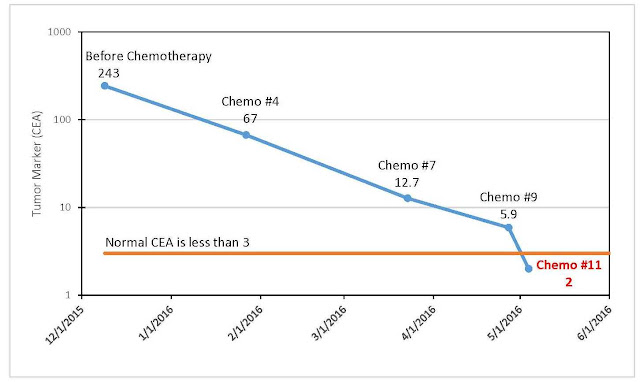
The last CEA test result was 2.0 which is in the range of a healthy person (less than 3.0). I'm normal! Well, as far as my CEA goes. The rest is debatable.
Because I like numbers and seeing results, I made a graph of my CEA progress. Doesn't everyone like a pretty graph?

The last CEA test result was 2.0 which is in the range of a healthy person (less than 3.0). I'm normal! Well, as far as my CEA goes. The rest is debatable.
Sunday, May 1, 2016
Chemo Brain
KNOXVILLE, TN - Chemo
Brain, also known as mush brain or fluff brain, affects millions of cancer
patients per year. It causes memory loss, forgetfulness, misunderstanding
directions, slow mental functioning, and mixing up numbers. The phenomenon is
thought to be caused directly by the combination of chemotherapy drugs and
impacts only the patient. However, a recent study by Peevler and Norris
published in The New England Journal of Medicine (2016), indicates that the
ailment may be spread to others. Research indicates that proximity and exposure
times are key factors that govern the severity of symptoms. For example a
person who interacts with the Chemo Brain Patient (CBP) daily will quickly see
their ability to remember details and short term memory dwindle whereas a
person who interacts with the CBP weekly might only experience minor forgetfulness.
Researchers did not evaluate the impact of digital interactions through
text messages or social media.
Researchers caution
against avoiding the CBP in their life but instead suggest developing their own
mental fitness regime. A mental fitness regime is also helpful for the CBP.
Boosting mental fitness includes using notes as reminders. A simple "Do
you have your keys" on the door or "Are you wearing pants?" on
the closet can avoid disaster. Developing conversational habits that encourage
both sides to recall a memory (i.e., do you remember how old you were when you
gave up eating paste) or explain a process (i.e., what is you preferred method
of boiling water) can help both parties. Cultivating the ability to listen to
the same story five times without letting on that you know how it ends is a
helpful skill that CBPs appreciate. Although not quantified by this study,
researchers believe that a sense of humor helps both the CBP and those close to
the CBP mitigate the stress associated with chemo brain until proper mental
functioning returns.
Subscribe to:
Posts (Atom)